How Grace Kelly’s wedding to Prince Rainier secured the principality’s future and shaped the careers of some of Europe’s most influential designers
Grace Kelly’s wedding to Prince Rainier III of Monaco in April 1956 was a fairytale event
for the public – glamorous, regal, and cinematic. Behind the scenes, the reality was more
complex, filled with political, emotional, and personal tensions. Nonetheless, the event
ushered in a new era and image for the principality of Monaco on the global stage and
shaped the careers of some of Europe’s most influential fashion designers.

Prior to the wedding, Monaco was economically weak, politically fragile, and essentially
seen by France as a protectorate. The Second World War and its aftermath had shifted
European politics, with France under Charles de Gaulle wanting greater control over
nearby microstates.
There were serious concerns in France that a succession crisis or instability in Monaco
could open the door to foreign (particularly American) influence – unacceptable in the
Cold War climate. France had a strong strategic and financial interest in Monaco and, in
the absence of a direct heir to Monaco’s throne, it could easily argue for absorption or
control.
In particular, the Franco-Monegasque Treaty of 1918 loomed over the Grimaldis. Signed
after the First World War, this treaty formalised Monaco’s close dependence on France,
especially in foreign policy and military matters. Crucially, it stipulated that if the
Grimaldi family failed to produce an heir, the principality would revert to French
control. The treaty was designed to prevent Monaco from falling into the hands of any
hostile or non-French-aligned powers, which was especially important in the post-WWI
and pre-WWII world. When Prince Rainier came to the throne in 1949, he was
unmarried and childless, and the threat of Monaco eventually reverting to France was
not theoretical but built into its legal foundation.

Without a legitimate heir, the Grimaldi dynasty, which had ruled Monaco since the 13th
century, could potentially die out. This would risk political instability and possibly the
loss of Monaco’s sovereignty. As a result, Prince Rainier III was under considerable
pressure to modernise the economy and ensure dynastic stability.
By the mid-1950s, Rainier needed to find a suitable bride urgently to produce an heir
and secure the dynasty, raise Monaco’s profile internationally and to help him distance
Monaco from French control and create a modern image for the principality.
He had reportedly been courting several aristocratic women, but none were quite
suitable, or willing, to take on the role. He wanted someone young, Catholic, elegant, and
charismatic.
Advisors and allies like the Greek shipping magnate Aristotle Onassis and the French
press began promoting Rainier as a bachelor prince in need of a suitable, dazzling wife.
During this period, Marilyn Monroe’s name came up in the gossip columns and even
among some business circles as a glamorous candidate.
She was the most famous woman in the world, a symbol of modern femininity and
beauty, and American, which had soft power value in postwar Europe. However,
Monroe was Protestant, divorced, sensual in her public image, and controversial – all red
flags for the Catholic Grimaldi dynasty and the ultra-conservative Monaco court.
Additionally, at a time when studios had immense control over their starlets, it was
deemed unlikely that 20th Century Fox would back the match.
Pierre Galante, editor of the French magazine Paris Match and the husband of American
actress Olivia de Havilland, helped arrange a photo op between Grace Kelly and Prince
Rainier during the 1955 Cannes Film Festival, where Grace was attending as part of a
Hollywood delegation.

1956
Galante believed that a romantic connection between an American movie star and
European royalty would generate massive press interest – and he wasn’t wrong.
He organised the meeting at the Prince’s Palace in Monaco, framing it as an innocent
promotional event. Grace wore a conservative dress and gloves; Rainier showed her the
royal gardens and his private zoo. There was instant charm, but not necessarily love at
first sight.
Onassis, for his part, was already deeply invested in Monaco. He held significant shares
in the Société des Bains de Mer, which controlled Monaco’s casino and tourism
economy. He also had ambitions to turn Monaco into a tax haven and a luxury hub.
Onassis reportedly encouraged Rainier to marry a glamorous American to attract
attention, investment, and wealthy visitors. Grace Kelly, with her image as a beautiful,
feminine, Catholic Hollywood actress, would bring both suitability and star appeal to the
match.
MGM, Grace’s studio, played a huge role in the wedding. In exchange for allowing Grace
to break her 7-year contract early to marry Rainier, MGM retained the rights to film the
wedding and broadcast it globally. The event doubled as a PR spectacle and a real-life
“movie”. With the studio dictating many visual aspects, including her costumes and
accessories.
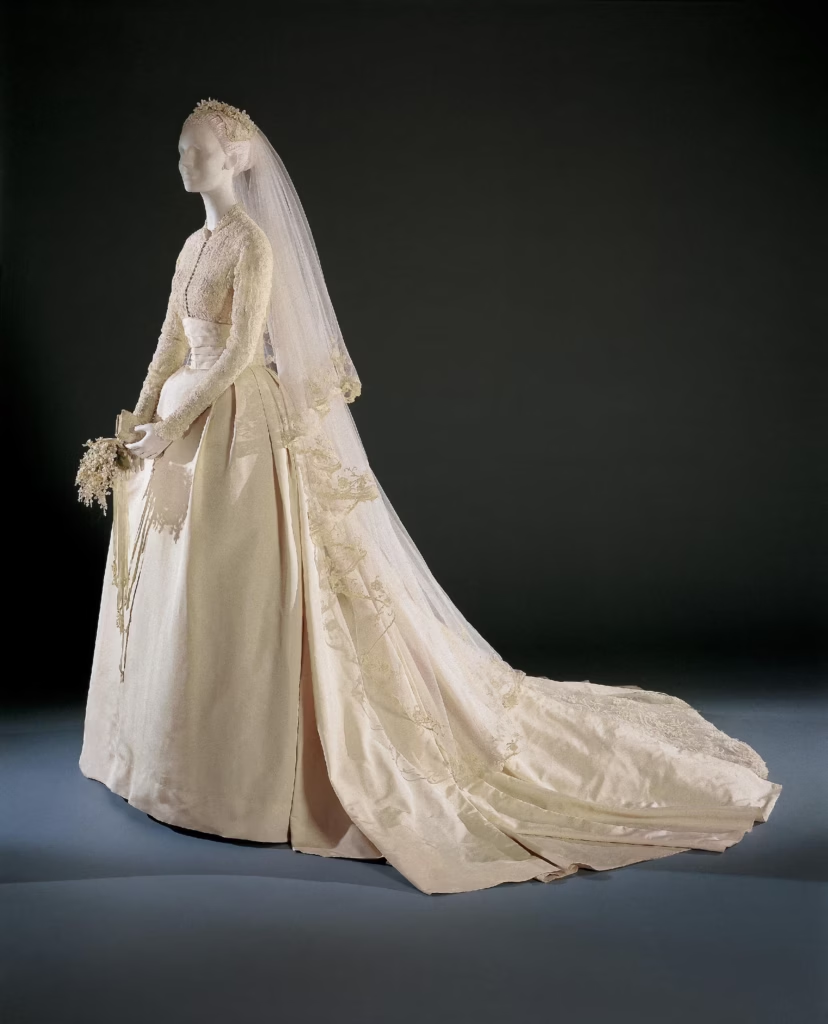
Her iconic dress, designed by MGM costume designer Helen Rose, was a studio
production, symbolically blending Hollywood and royalty. The dress was even an
official gift to Kelly from MGM, where she was still under contract.
Where Prince Rainier’s military dress uniform was self-designed, the red and gold tones
echoing the grandeur of Monaco’s royal tradition and emphasising the stately aesthetic
of the event. Grace’s gown was shaped and sculpted to be an article of clothing befitting
the “wedding of the century.”
Helen Rose had worked with Grace before, most notably on the films High Society and
The Swan, and already had two Oscars to her name, making her an ideal candidate to
design the ceremonial gown.

The dress itself was made from delicate Brussels lace, re-embroidered with pearls, the
high-necked bodice featuring long sleeves and a demure, princess-like silhouette. The
lace Rose selected was over a century old. Grace’s bell-shaped skirt was crafted from
ivory peau de soie (an especially soft silk) and supported by petticoats and a crinoline.
The dress’s train was over ten feet long. Silk was also used to make the veil, which was
designed to ensure Grace’s face was still visible to the estimated 30 million people who
watched the wedding broadcast from the comforts of their homes. Instead of a tiara,
which may have clashed with the softness of her veil or drawn attention away from her
face, Grace wore a Juliet cap made of lace and seed pearls and carried a small bouquet of
lilies of the valley.

Crafted with both style and strategy in mind. Grace’s wedding dress became Rose’s most
famous creation and forever associated her name with timeless bridal elegance. The
impact was industry-wide. Lace bodices and long sleeves came back into vogue, the
dress and wedding attire crystallised mid-century ideals of bridal purity and nobility,
and the monumental nature of the occasion helped Rose’s design to lay the foundation
for the multi-billion-dollar designer bridal industry which maintains a worldwide span
today.
Several modern designers have also credited the dress as a defining influence on their
own work, particularly in bridal fashion. Oscar de la Renta, known for romantic, refined
gowns, frequently cited Grace Kelly’s style as a benchmark for elegance. While Vera
Wang, who herself reinvented bridal fashion in the 1990s, likewise referenced Grace
Kelly as the epitome of classic bridal style. The romantic silhouettes of Elie Saab and
Zuhair Murad also owe a stylistic debt to Grace’s princess-like elegance, even as their
own designs have become revered for their high-impact embellishments.
In 2011, Sarah Burton designed Kate Middleton’s wedding gown for Alexander
McQueen and heavily referenced Grace’s lace bodice, long sleeves, and full skirt,
reviving the Grace Kelly look for a new generation.

Designed by Oscar de la Renta

Designed by Alexander McQueen
It is a testament to Helen Rose’s design, and the modern designers who followed and
finetuned her style in their own work, that, while the political and economic intrigues
that brought the wedding into being are largely forgotten today, Grace Kelly’s iconic
wedding dress not only sealed the wedding of the century but immortalised an aesthetic
that shaped the ambitions and careers of bridal designers for decades, and still does.